

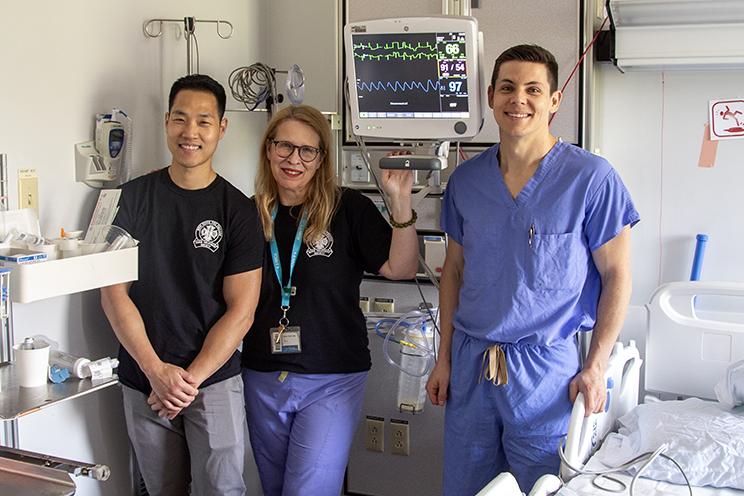
(L-R) Brian Cho, physiotherapist; Elinor Kelly, clinical lead; and Dr. Jack Rasmussen, QEII critical care physician, plastic surgeon and director of the QEII’s Burn Unit, show off the new monitors at the Burn Unit’s new four-bed Intermediate Care Unit (IMCU). The monitors were purchased through a generous donation to the QEII Foundation from the Nova Scotia Fire Fighters’ Burn Treatment Society. QEII FOUNDATION
New IMCU opens at QEII’s Burn Unit, thanks to fundraising by the Nova Scotia Fire Fighters’ Burn Treatment Society
Thanks to community fundraising led by the Nova Scotia Fire Fighters’ Burn Treatment Society, the QEII Health Sciences Centre opened a new four-bed Intermediate Care Unit (IMCU). This dedicated space ensures burn patients receive continuous, highly specialized medical care.
“We can now monitor patients at a higher level within the Burn Unit,” says Dr. Jack Rasmussen, QEII critical care physician, plastic surgeon and director of the QEII’s Burn Unit.
The Nova Scotia Fire Fighters’ Burn Treatment Society’s generous donation to the QEII Foundation of more than $132,000 allowed for the purchase of IMCU monitors for the burn unit. The monitors, which track everything from blood pressure and heart rate to oxygen saturation and cardiac rhythm, allow Dr. Rasmussen and his team to now deliver a higher level of care directly to patients in the Burn Unit. Previously, if they needed that level of care, they went to another inpatient unit or the Intensive Care Unit (ICU).
“Patients with major burns require intensive care,” he says. “Before we had these monitors some patients were spending additional days in the ICU.”
Having burn patients stay in the 12-bed ICU for longer than necessary wasn’t optimal for patients or the best use of healthcare resources, says Dr. Rasmussen. The Burn Unit’s new monitors have not only created better patient care but have improved the region’s critical care capacity. The Burn Unit is a referral centre for the Maritimes.
“To get this project off the ground is a huge win for the patients, and the healthcare system,” says Dr. Rasmussen.
In preparation for the four IMCU beds opening last March, nurses on the six-bed Burn Unit received additional education and training. “We provide extremely specialized care,” says Elinor Kelly, a registered nurse and clinical leader for burns and plastics.
Complex dressing changes for patients with major burns covering more than 60 per cent of their bodies often require sedation, says Elinor. Before the IMCU beds opened on the Burn Unit these dressing changes might take place in an operating room to ensure adequate patient monitoring.
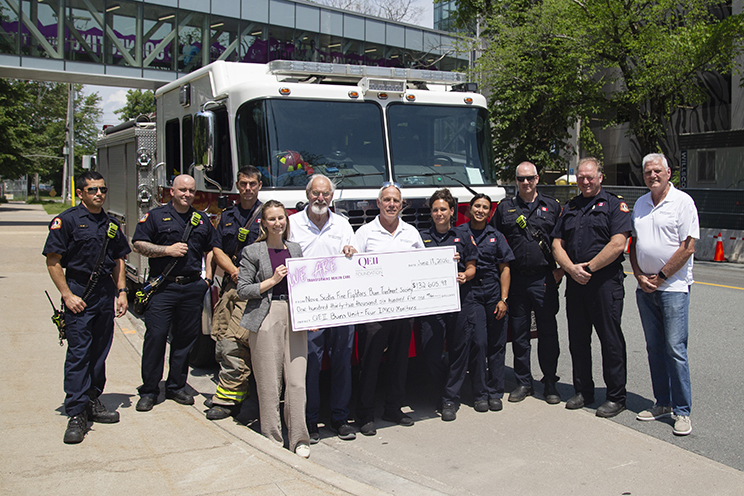
Outside of the QEII’s Halifax Infirmary building, representatives from the Nova Scotia Fire Fighters’ Burn Treatment Society present a cheque to the QEII Foundation. Through their fundraising, they were able to provide new monitors to the QEII’s Burn Unit, allowing them to open an Intermediate Care Unit for burn patients. QEII FOUNDATION
Dave Collier, a retired firefighter and chair of the Nova Scotia Fire Fighters’ Burn Treatment Society’s board of directors, is proud of the fundraising efforts of firefighters and paramedics across the province.
The money raised to purchase the IMCU monitors came from a wide range of events including an annual bowl-a-thon, a golf tournament, the popular Nova Scotia Fire Fighters 50/50 Draw and small BBQs held by individual fire departments.
“We love to have a project we can get behind,” says Dave.
Started in 1982 by a group of Halifax firefighters, the Nova Scotia Fire Fighter’s Burn Treatment Society was incorporated in 1983. Since then, the non-profit charity has contributed burn care equipment and educational materials to local hospitals, and assisted burn survivors with post hospital care.
“It gives you a sense of pride and accomplishment knowing you are helping,” says Dave. “It gives you the feeling that you are making a small difference.”
Today, the Society involves firefighters from across the province, as well as staff from the QEII’s Burn Unit — several of whom are involved with Camp Connect, the society’s summer camp for burn survivors.
In addition to the society’s donation to purchase IMCU monitors, another $10,000 was given to the Burn Unit to buy a specialized shower chair. The chair allows patients to safely have a shower which provides them with both comfort and rehabilitation.
“It is about returning function to people,” says Elinor. “The patients tell us we saved their lives. We get very close to them.”
Dr. Rasmussen foresees the strong collaboration between the QEII and the firefighters’ society continuing for a long time.
“Firefighters see burn victims at their worst when rescuing them from the scene of a horrendous injury,” says Dr. Rasmussen. “They rarely get the chance to follow up on these patients. Our collaborative partnership with the firefighters’ society gives them the opportunity to see how some of these patients recover.”