

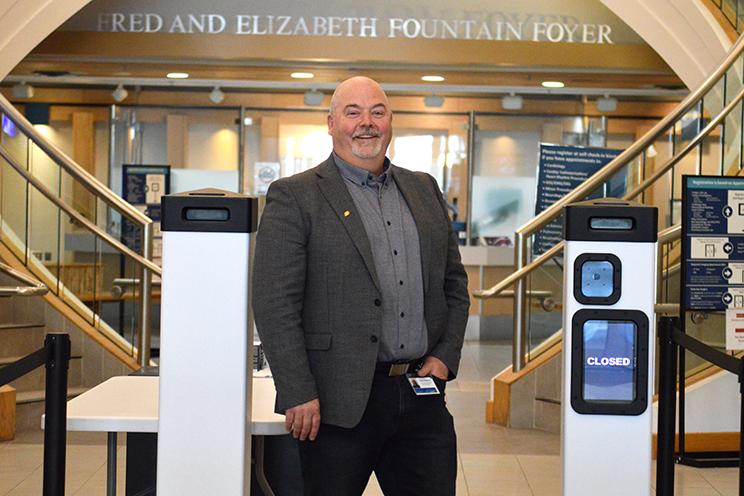
Dean Stienburg, director of security for Nova Scotia Health, stands in front of the new AI weapons-scanning technology at the QEII. Nova Scotia is the first province in Canada to use this specific type of technology in hospitals, with 3,218 items deterred from entering the QEII in the first three months of implementation. QEII FOUNDATION
New security technology helping to identify potentially dangerous items
Thousands of potentially dangerous items have been prevented from entering the QEII Health Sciences Centre’s Halifax Infirmary since the installation of AI-based weapons scanners in December 2025.
Nova Scotia is the first province in Canada to use this specific type of technology in hospitals following a successful pilot program at Colchester East Hants Health Centre in Truro, which was supported through the $7-million Safety and Innovation Fund, a collaborative initiative between the Province of Nova Scotia and the Nova Scotia Council of Nursing Unions to address workplace safety concerns and reduce violence in healthcare settings.
Isaac McGuire, assistant manager, Central Zone security, says the AI scanners will enhance safety for patients, visitors and healthcare providers and help prevent serious incidents like the one that happened at the emergency department of the Halifax Infirmary in January 2025.
According to Isaac, more than 308,000 people were scanned at the QEII from December 13, 2025 to mid-April 2026, and 3,218 items were deterred from coming into the Halifax Infirmary building. Many of the items denied were knives of different types, along with scissors, hardware tools, box cutters, razor blades, chemical sprays, and ammunition.
Enhanced with AI machine learning, he says the weapons detector system is significantly faster for scanning large volumes of people than traditional metal detectors, creating a better experience for patients and visitors.
Designed to screen for potentially dangerous items while keeping a very fast flow, Isaac says the AI reads the reading of the metal detector and learns over time what items might be made from metal but aren’t inherently dangerous.
“The machine has been trained on thousands and thousands of people passing through wearing belt buckles and has learned how to determine what is a belt buckle and what might be a knife on your belt and it will alert on the knife, but not on the belt buckle,” he explains.
The easiest way to get through the scanning process, he says, is for people to change their perception and be mindful about what is allowed to be brought into a healthcare environment.
Although wait times have been minimal so far, Isaac is encouraging patients to arrive five to 10 minutes early and whenever possible, bring only the items needed for their appointment. The scanners are currently very efficient at scanning the person, but there are limitations when it comes to bags because of the way contents are concentrated together inside.
“Bags are searched manually,’’ he goes on to say. “We’re certainly not putting any restrictions on what can be brought in, but those will have to be looked through. Ways to speed up the process is to only bring things that are essential, but if you are bringing many items, bring them in a reusable bag which can be easily looked through rather than a backpack that has multiple pockets.”
Although removing unacceptable items from the facility is always the preferred option, Isaac says 24 single-use amnesty lockers with a one-time programmable digit code are available at the QEII where items can be placed and picked up as people leave. Security staff can also assist with their disposal.
As director of security for Nova Scotia Health, Dean Stienburg says they’ve had fewer issues than anticipated and the public has been very accepting and understanding of the process overall.
“The machines are working well and our through time is very good. We are keeping many items out of the hospital that don’t need to be there and are potentially dangerous,” he shares.
Although the violent incident at the Halifax Infirmary in 2025 was a catalyst and an accelerator to the implementation of the new technology, Dean says they have been facing a rise in violence and its severity in the hospitals for the past four or five years.
“This is long needed and we’re very happy now with the results of it.”
It only takes about 10 seconds for individual patients and visitors to pass through the scanner. If they’re carrying a bag, which needs to be searched manually, it typically takes 30 seconds to a minute, depending on the size and number of bags. This efficiency was one of the driving factors to acquiring this type of technology.
There has been a monthly decline in the number of items being turned away — the message is getting out there and people are giving some forethought when they’re coming to the hospital and are leaving potentially problematic items they don’t need in their vehicle or with someone waiting for them.
Dean says the AI weapons scanners are only one component of a larger plan to improve safety and security in the hospital. A few different initiatives are underway including the addition of staff duress alarms, increased training, and equipment available to security services to provide a more comprehensive response overall for security, but particularly to violent incidents.