


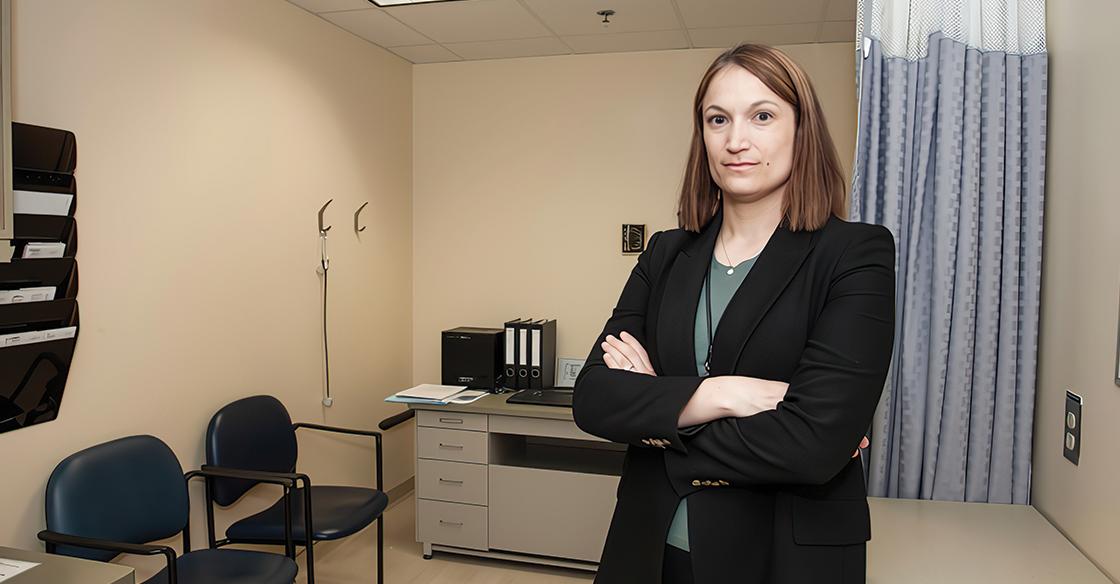
Pictured: Dr. Alexandra Legge, the Quigley Family Endowed Chair in Rheumatology
Over one year in, the donor-funded Quigley Family Endowed Chair in Rheumatology is strengthening research, growing local expertise and helping shape the future of arthritis and rheumatology care.
For more than one in five Nova Scotians living with arthritis, the condition is far more than occasional aches and pains. From chronic pain and mobility challenges to the impact on everyday activities, arthritis and related rheumatic diseases can profoundly affect a person's quality of life. But thanks to the generosity of QEII Foundation donors, important research and new approaches to care are gaining momentum right here in Nova Scotia.
Established in 2025, the Quigley Family Endowed Chair in Rheumatology is the first research chair of its kind in the province — a donor-funded position dedicated to advancing research, attracting talent and improving care for people living with arthritis and other rheumatic diseases.
Made possible through the collective generosity of hundreds of QEII Foundation donors, including the Quigley family, the Chair is already making a meaningful impact with its inaugural chairholder Dr. Alexandra Legge.
ADVANCING RESEARCH WITH THE POTENTIAL TO CHANGE LIVES
Dr. Legge, a rheumatologist and clinician-scientist at the QEII Health Sciences Centre, is leading a growing research program focused on understanding complex rheumatic diseases and improving patient outcomes.
One important area of research is frailty in people living with rheumatic diseases — an emerging field that could help healthcare teams better identify vulnerable patients, personalize treatment and support healthier aging.
Over the past year, Dr. Legge and her team published the first study applying a laboratory-based frailty index in people living with lupus, a complex autoimmune disease that can affect multiple organs throughout the body.
Her team is also building on the Lupus Brain Map Study, originally launched by Dr. John Hanly, using existing research data alongside new findings from advanced brain imaging to better understand how lupus affects cognition and brain health. This ongoing work holds promise for improving how challenging neurological and psychiatric complications of lupus are understood, diagnosed and managed.
Beyond the research itself, Dr. Legge is helping translate scientific evidence into better patient care. Her contributions to two published clinical practice guidelines for lupus and lupus-related kidney disease are helping inform how healthcare providers manage these complex conditions. Her growing expertise is also gaining national and international recognition, with 15 peer-reviewed publications authored or co-authored over the past year alone.
One of the most significant impacts of the Quigley Family Endowed Chair is the opportunity to build a stronger, more sustainable research program. Donor funding has enabled Dr. Legge to dedicate more time to research while supporting the recruitment of a new research coordinator and research assistant. The Chair is also helping develop the next generation of rheumatology researchers — an investment Dr. Legge is particularly excited about.
"We welcomed our first PhD trainee in September 2026, who will be focusing her research on how lupus affects the brain," shares Dr. Legge. "It's an exciting milestone for our program and another example of the opportunities this Chair is making possible."
As Dr. Legge explains, the Chair is also creating capacity for new projects, including ECHO-Maritime Rheumatology, an innovative education and mentorship initiative designed to support primary care providers across the Maritimes. By strengthening healthcare providers' knowledge and confidence in managing rheumatic diseases, the program aims to improve access to high-quality, evidence-based care for patients, including those living outside major urban centres.
EMERGING RESEARCH INTO LYME ARTHRITIS
With Nova Scotia reporting the highest rates of Lyme disease in Canada, Dr. Legge and the team are also advancing research into Lyme arthritis — a potentially serious complication that causes painful joint inflammation and swelling.
Working alongside Dr. Elizabeth Stringer, a pediatric rheumatologist at IWK Health and a leader in childhood Lyme arthritis research, they're exploring important gaps in how the condition is diagnosed and treated.
While most patients respond to antibiotics, some experience persistent inflammation despite treatment. Distinguishing between an ongoing infection and lingering inflammation can be challenging, creating uncertainty around the most effective care.
Their work includes a recently completed review of Lyme arthritis cases seen at the QEII over the past 15 years and an ongoing national survey of Canadian rheumatologists. With additional funding, researchers also hope to establish a study following adult patients over time, building on existing pediatric research to better understand differences in treatment responses and long-term outcomes.
Together, this work could help identify patients at greater risk of persistent arthritis, inform more personalized treatment approaches and position Nova Scotia as a leader in this emerging field.
A LASTING INVESTMENT IN THE FUTURE OF RHEUMATOLOGY CARE
Behind all of these advancements is an extraordinary community of donors who believe in the power of research to change lives.
Among them is the Quigley family, whose more than two decades of philanthropic leadership have helped advance rheumatology research and care at the QEII. Together with hundreds of other donors, their generosity has created a lasting investment in research, innovation and the future of patient care.
Unlike traditional research grants, endowed chairs provide sustained funding that supports researchers year after year, creating the stability needed to pursue ambitious ideas and build long-term research programs.
For Dr. Legge, that support has been a game-changer.
"The protected research time afforded by the Chair has been truly transformative for my own work, enabling the uninterrupted time for deep thinking and creativity that is essential for impactful research," says Dr. Legge.
"The impact of this gift will extend far beyond our current work, helping to build the future rheumatology research workforce and fostering discoveries that will improve rheumatology care for years to come."
From advancing our understanding of lupus and frailty to developing new initiatives designed to strengthen care across Nova Scotia, the Quigley Family Endowed Chair in Rheumatology is demonstrating what's possible when a community invests in research.

