

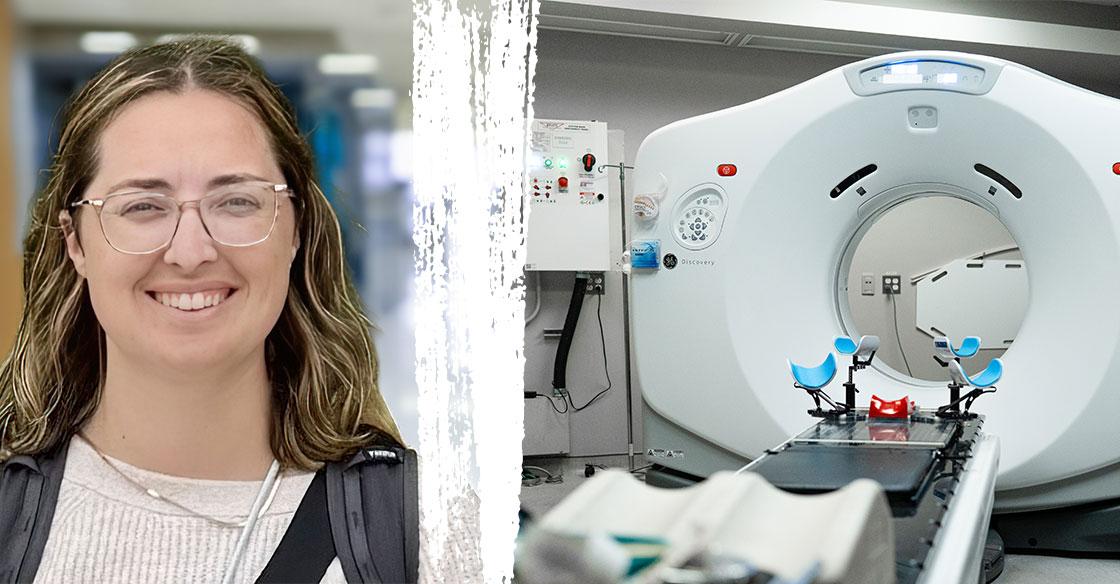
Pictured (L-R): QEII radiation therapist, Kim Watson; and one of two, new CT simulators funded by QEII Foundation donors.
Behind every radiation treatment plan is a dedicated team using advanced imaging technology to map care with remarkable precision.
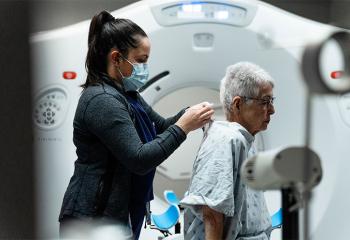
One of the most important tools in that process is CT simulation. Unlike a traditional CT scanner used to detect cancer, a CT simulator captures highly detailed, three-dimensional images of a patient's body in the exact position they will be in during radiation therapy. These images allow clinicians to accurately map tumours while protecting surrounding healthy tissue — laying the foundation for safe, effective treatment.
Thanks to the generosity of more than 1,250 QEII Foundation donors, cancer care teams at the QEII now have the ability to support more patients each day. Donor support through the QEII Foundation’s We Are campaign funded two new CT simulators — a $3.6-million project replacing aging technology while also adding a second, net-new scanner that has doubled CT simulation capacity. This exciting project was made possible, in part, by a $1-million leadership gift from the Kenneth and Dorothy Rowe Foundation, creating the Kenneth and Dorothy Rowe Foundation CT Simulation Suite, where thousands of Nova Scotians now receive the vital imaging that guides their radiation treatment.
Our donors’ impact has been immediate and far-reaching.
In 2025 alone, QEII teams performed 3,181 CT simulation scans. With two state-of-the-art CT simulators now in operation, teams can typically scan up to 16 patients each day — and as many as 18 to 20 during periods of peak demand.
Before the expansion, a single machine limited capacity to approximately 10 to 12 patients daily.
We recently interviewed Kim Watson, a radiation therapist at the QEII Cancer Centre, to learn how this We Are project is enhancing both the patient experience and day-to-day work of cancer care teams. From improving precision to creating a more seamless path into treatment, her perspective offers a behind-the-scenes look at what donor generosity is making possible for cancer patients every single day.
Q: WHAT DIFFERENCE HAS HAVING TWO CT SIMULATORS MADE FOR YOUR TEAM AND PATIENTS?
KIM: Having two scanners has given us much more flexibility in the types and volume of cases we can take on each day. One of the biggest impacts has been our ability to better support emergency add-on cases without disrupting other patients already scheduled for care.
There are times when patients urgently need same-day radiation treatment — often because they’re in a pain crisis or have a tumour pressing on their spinal cord that’s affecting their ability to walk or function. Before, fitting those patients in could significantly impact the rest of the day’s schedule. Now, we can respond much faster while still keeping other patients moving through the system. That’s been a game-changer for both patients and staff.
Q: HOW HAS THE NEW TECHNOLOGY IMPROVED THE PATIENT EXPERIENCE?
KIM: The new scanners have allowed us to update many of our protocols, including introducing IV contrast-enhanced CT simulation for the very first time. That gives us clearer scans, helps improve radiation treatment planning and can remove the need for additional imaging appointments in Diagnostic Imaging.
The CT simulation scans themselves are also now very quick — usually less than a minute — while still producing very high-quality images. Overall, it’s helping patients move through the process more efficiently and get onto their treatments sooner, which can make a huge difference during an already stressful time.
Q: IN ONE SENTENCE, WHAT SHOULD DONORS KNOW ABOUT THE IMPACT THEY’RE HAVING?
KIM: These new CT simulators are helping us get patients onto treatment with the highest-quality plans possible — and that impact is felt every single day by patients and our cancer care team.