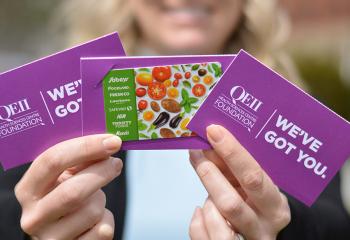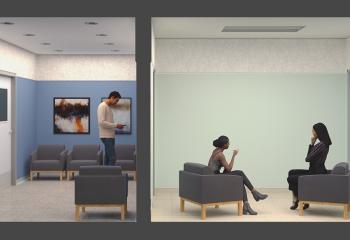


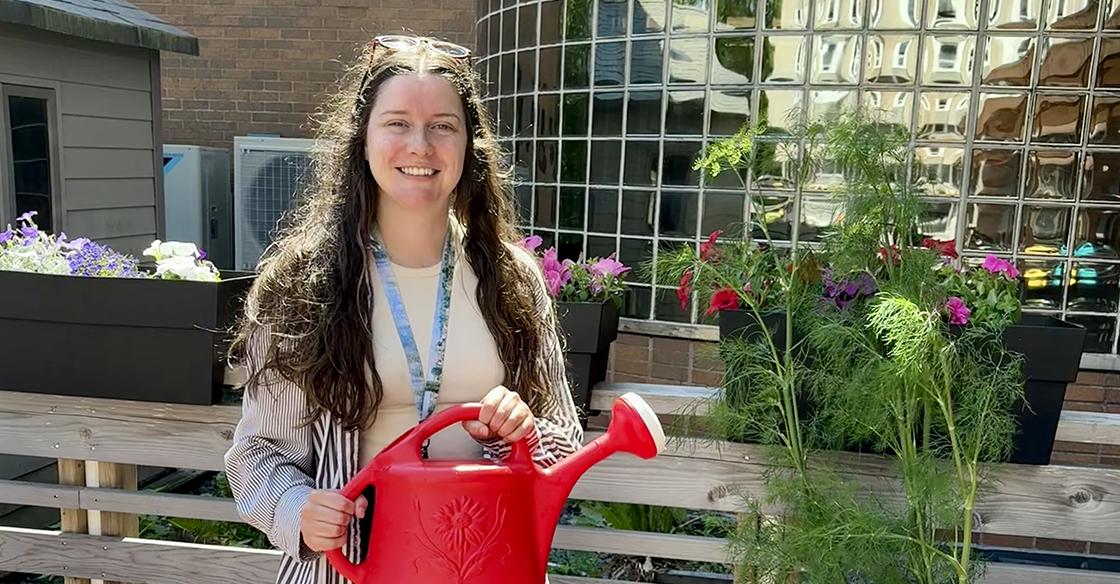
QEII social worker Sarah Coleman in the QEII's Abbie J. Lane Building’s Mental Health Day Hospital Wellness Garden. She is grateful for the support of donor-funded QEII Patient Essentials Fund gift cards, which she can provide to patients accessing the Day Hospital Program to help cover essentials like gas, groceries, personal care items, and medications.
When Sarah Coleman arrives at work each morning at the Mental Health Day Hospital inside the QEII’s Halifax's Abbie J. Lane Memorial Building, she carries with her a learned understanding of what her patients are up against. Not only the mental health challenges that brought them through the door, but everyday burdens that can make treatment more challenging.
As a social worker in the Day Hospital's outpatient program, Sarah works alongside a team of registered nurses, a psychiatrist, an occupational therapist, a clinical therapist, and a recreational therapist to support Nova Scotians navigating mental health challenges. The program, which is just four years old, offers an intensive four-week daily outpatient program designed to help patients facing an acute mental health episode and aims to help patients avoid hospitalization or transition safely home after an inpatient stay.
"The goal of the Day Hospital is to provide structure and routine, educational and skills based groups, as well as recreation and leisure programming, and also support people to be in their home at night," Sarah explains. "And not have to be hospitalized if they don't need to be."
Patients are referred to this program by psychiatrists and arrive from a variety of entry points, ranging from community mental health clinics across Nova Scotia’s Central Zone, psychiatric emergency services, and inpatient stays.
What these patients often share, beyond the acute mental health concerns that brought them there, is often something that can make their situation even more difficult: the financial strain of navigating a health challenge.
"Often we find that people are off work when they're attending our program, and so their finances are more limited than they would usually be," says Sarah.
This is where the QEII Foundation's Patient Essentials Fund has become what Sarah describes as one of the most important resources at her disposal.
A simple gesture making a difference
Now celebrating its fifth anniversary, the QEII Patient Essentials Fund provides donor-funded gift cards that frontline care providers can give directly to patients when basic needs become barriers to accessing and focusing on care and recovery.
The uses are varied and practical. From groceries to gas to personal care items and medications, QEII Patient Essentials Fund gift cards help QEII patients facing financial need access the most basic, human essentials while navigating an illness or injury.
Since its inception in 2021, the QEII Patient Essentials Fund has raised $586,000 and put more than 18,000 gift cards into the hands of healthcare staff like Sarah, who explains that the support helps alleviate some of the financial burden of attending the Day Hospital’s four-week program.
“We often hear that finances are a primary stressor in people’s lives. Real life stressors can impact patients’ ability to fully focus on our programming and their mental health recovery,” says Sarah.
"[Gift cards] can help support folks in the interim if they are struggling with the cost of living, or have reduced income and the same expenses as they normally do.”
For patients at the Day Hospital, sometimes the need is food. Sometimes it's hygiene supplies. But one of the most critical applications Sarah has found is helping patients access their medications.
"A lot of folks come to the Day Hospital, particularly if they come from emergency, and they haven't been connected to a system in a while," she explains. "They might not have medication coverage, and they don't have the means to pick up their medication by themselves. They're choosing between rent or medications. Those are really tricky situations."
For patients in that position, a gift card can mean the difference between accessing a much-needed prescribed medication or covering food and housing costs, potentially for weeks, while other coverage is being arranged. Sarah, whose role includes connecting patients with income support and other resources, knows those processes take time.
"Those things can take weeks to kick in," she says. "So, it gives people the ability to buy food in the meantime."
Travel is another barrier to care that the QEII Patient Essentials Fund helps support patients with. Because the Day Hospital serves patients from across Nova Scotia’s Central Zone, some patients face significant daily commutes.
"Sometimes that’s a lot of kilometers to travel, and that's a lot of gas money," Sarah notes. "So, we can provide them with gas gift cards if that's going to be a barrier for the patient and the family."
Going beyond money: dignity and relief
Sarah explains that the most common reaction she sees when handing a patient a gift card is gratitude.
She says that the immediate, tangible nature of the gift cards allows patients to address their needs in a timely, direct way, alleviating stress for themselves and their families.
"People are very grateful. I think there's a lot of relief when you're able to provide access to an essential or a basic need that they're otherwise having trouble getting. Whether that be a gift card for food or gas – just a lot of gratitude and relief."
She also emphasizes that the impact goes beyond the transaction itself, touching something deeper about how patients feel seen and supported in their care.
"I would say to not underestimate the gravity of the dignity, autonomy and relief that a gift card can provide."
This feeling of support can make all the difference to patients facing difficulties, as it’s a hopeful reminder that someone cares about their journey.
Filling an essential gap
Sarah is candid about what it would look like if support from the QEII Patient Essentials Fund wasn’t available. Without these gift cards on hand, she says, there simply isn't an equivalent solution currently available.
"I think one of the biggest challenges we experience as clinicians, is sometimes it is very easy to know what somebody needs and not be able to give that. We don't have a budget to cover things like this."
That burden can weigh heavily on frontline care workers, who may see hundreds of patients in similar situations each year.
"If I don't have the gift card, there is not an easy way for me to support them."
That’s why she and her colleagues were so relieved when, thanks to donor support, the QEII Patient Essentials Fund recently increased the value of individual gift cards from $25 to $50. This change has made a difference in what the cards can cover.
"That has been huge just with inflation," she says.
By equipping healthcare providers with a way to provide patients with immediate financial relief, these donor-funded gift cards improve not just the lives of patients but uplift the experience and morale of healthcare workers who are driven to provide compassionate, timely care.
A message of gratitude
As the QEII Patient Essentials Fund marks five years of impact, made possible with donor support and the rallying of our surrounding community, Sarah is appreciative of the support.
"We are so appreciative and grateful of those considering the QEII Patient Essentials Fund as a meaningful place to donate to,” she says of people thinking about investing in this program.
“The value of that small donation can be so impactful on a person or a family – and even just on our ability to support people to alleviate stress and effectively engage with the treatment that they're getting here.”
For those who are considering supporting the fund, she offers this insight:
"It is difficult to imagine how much of an impact that kind of donation can have unless you've been in a situation similar to this, or you’ve supported someone in this situation and have been able to provide them with a way to cover their essential expenses."
Five years in, the QEII Patient Essentials Fund continues to steadily fill one of health care's most persistent gaps. Not with a radical change or new piece of technology, but with the direct ability to meet a person exactly where they are and help them take the next step during their care journey recovering from an illness or injury.
“As a social worker, this is one of the most important resources to me,” Sarah says. “I hope it continues to grow.”
To support the QEII Patient Essentials Fund and help patients like those served by the QEII’s Mental Health Day Hospital, visit https://qe2foundation.ca/current-priorities/qeii-patient-essentials-fund