

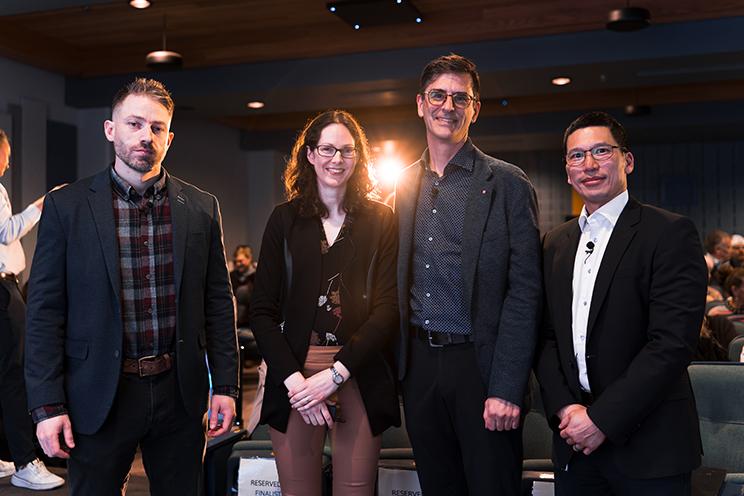
(L to R) Dr. Abraham Nunes, QEII psychiatrist; Dr. Amy Trottier, QEII hematologist; Dr. John Sapp, QEII cardiologist; and Dr. Ivan Wong, QEII orthopaedic surgeon, were the four finalists presenting at this year’s QEII Foundation Innovation Den. Dr. Trottier was the Grand Innovation Winner, awarded $200,000 for her work with new genetic testing for blood cancer patients. Dr. Nunes won the $75,000 People's Choice Award for his work in expanding care for patients with treatment-resistant depression. UNCHARTED.MEDIA
$275,000 awarded to bold local innovations transforming patient care in Nova Scotia
When passion, creative thinking and donor support combine, life-changing ideas can become reality. That’s what the QEII Foundation’s Innovation Den is all about. On April 16, in its third year, four of Nova Scotia’s top clinician-scientists took the stage at the QEII’s RBC Theatre to pitch their evidence-based research ideas to a panel of expert judges.
Two awards were up for grabs: the $200,000 Grand Innovation Award and the new $75,000 People's Choice Award.
"This is not your typical pitch competition," says Jennifer LaPlante, a member of the QEII Foundation's Board of Directors and deputy minister of Cyber Security and Digital Solutions for Nova Scotia, who emceed the evening. "We have researchers and clinicians with evidence-based ideas who are bringing them forward to impact patient care."
FOUR BOLD IDEAS
Each finalist presented a unique and forward-thinking solution, showing the range of healthcare innovation happening in Nova Scotia.
• Dr. John Sapp, QEII cardiologist, pitched the expansion of a pan-Canadian study on patients who survive the most dangerous heart rhythms.
• Dr. Ivan Wong, QEII orthopaedic surgeon, pitched a radiation-free 3D ultrasound that maps the hip joint in real time. This technology is meant to replace CT scans, which currently have an average wait time of 336 days at the QEII.
• Dr. Abraham Nunes, QEII psychiatrist, pitched expanding access to ketamine for people living with treatment-resistant depression.
• Dr. Amy Trottier, QEII hematologist, pitched a new way to do genetic testing for blood cancer patients using nail clippings versus skin biopsies.
THE GRAND INNOVATION AWARD
After a break filled with careful discussion, the judges made their decision.
Dr. Trottier won the $200,000 Grand Innovation Award. Her project focuses on research that could replace the current genetic testing for blood cancer patients, which involves an invasive skin biopsy that takes a month and specialized facilities to process, with a simple nail clipping and whole genome sequencing. In her pitch, she told the story of a patient whose bone marrow transplant plan changed after genetic testing showed his sister had the same hereditary change that caused his leukemia.
Dr. Trottier says the $200,000 will fund new lab equipment, whole genome sequencing and research staff. Her lab plans to make nail-clipping testing the new clinical standard within a year and a half. What’s unique about this project is that patients can benefit from it right away, even before the research is finished.
"Even while we're doing the research itself, we are getting real results and real answers that I bring right back into the clinic, and we change that patient's care and management," says Dr. Trottier.
Her message to the donors is simple.
"It means everything, and it makes the world of difference," says Dr. Trottier. "The QEII Foundation is a huge strength for researchers in our local area. It drives the quality of research and enables early career researchers like myself to get their work off the ground."
THE PEOPLE'S CHOICE AWARD
The inaugural $75,000 People's Choice Award went to Dr. Nunes, presented by Dave Shea, chair of the QEII Foundation's Leadership Giving Group and chief technology officer at Kraken Robotics. The award was selected by a group of donors who each contributed $5,000 or more to the Innovation Catalyst Fund.
Dr. Nunes plans to use the funding to study real-world data on at-home ketamine use, which is taken under the tongue. This fast-acting treatment can help some people with treatment-resistant depression feel better in just one or two weeks. His goal is to create safe, scalable protocols that could give new options to patients who feel they have none left.
"My whole drive and purpose is to provide people who feel like they have no other options, with hope that they do have other options and that they can feel better," says Dr. Nunes.
For Dr. Nunes, being chosen by donors who personally supported the fund means a lot.
"It's a responsibility I have to fulfill," says Dr. Nunes. "That's somebody who's putting their own money on the line, which means that they really believe in it."
GREAT IDEAS, TOUGH CHOICES
Finalists at the Innovation Den were judged on clear criteria: having a defined goal with ways to measure success, potential to grow, and the ability to improve clinical care and patient outcomes.
For judge Dr. Karen Cross, CEO and co-founder of MIMOSA Diagnostics, all of the pitches were deserving.
"The four people that pitched have ideas that don't just transform medicine in Nova Scotia — they transform medicine for the world," says Dr. Cross. "It was a really difficult decision. Someone has to be chosen ultimately in the end, but I believe we'll see all of them very soon making that impact."
THE POWER OF PHILANTHROPY
The QEII Foundation’s Innovation Den is funded by the Innovation Catalyst Fund, which started in 2023 with a $1-million gift from Susan Crocker and the late John Hunkin. Since then, both major and everyday donors have contributed, including a $50,000 gift from CIBC this year in John’s honour, along with leadership donors who made the People’s Choice Award possible.
"This is the power of philanthropy," says Jennifer during the evening.
Meanwhile, Dr. Trottier, for her part, closed her Innovation Den pitch with a line that captured the whole night.
"With your support, we can turn fear of the unknown into answers, and answers into hope."