

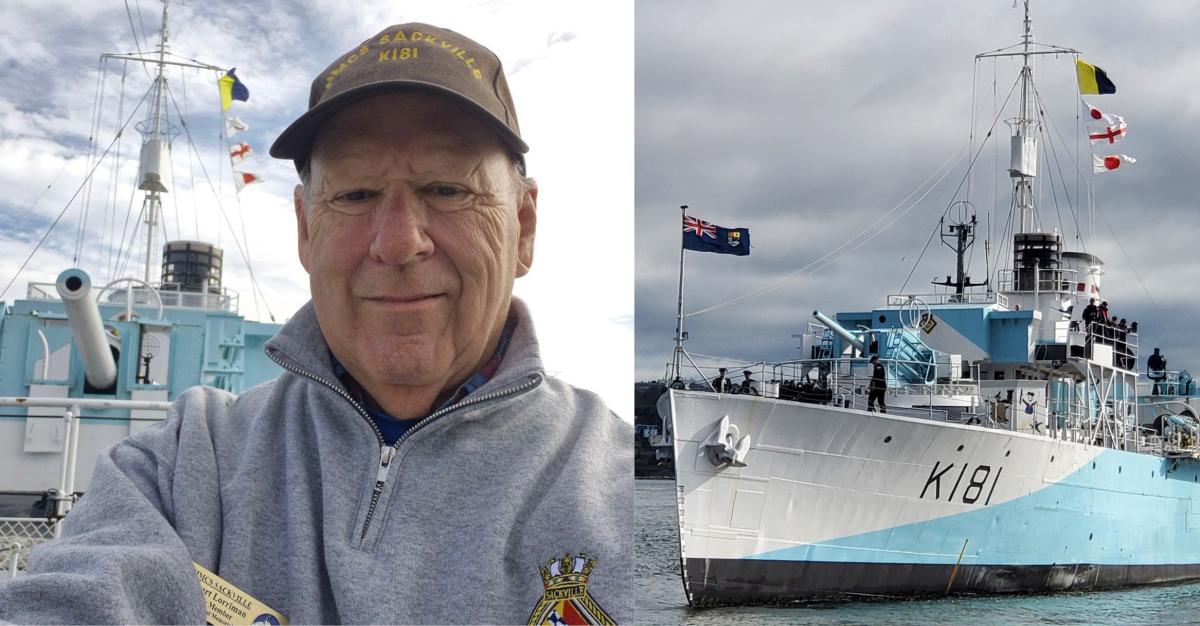
Stuart Lorriman, pictured with the HMCS Sackville, where he volunteers as a tour guide. In December 2025, Stuart received a life-changing TAVI procedure at the QEII Health Sciences Centre, a minimally invasive surgery to replace an aortic heart valve.
At age 75, Stuart Lorriman lives in Head of Saint Margaret’s Bay in Nova Scotia, where the rhythm of his life is shaped by the ocean, history, and a sense of connection. With a deep appreciation for ships and sailing, he spends three days a week volunteering guiding visitors through stories of the sea on the Halifax Waterfront at the Maritime Museum of the Atlantic and aboard the HMCS Sackville.
Not long ago, his life veered unexpectedly into rougher waters.
For decades, Stuart had been told by his family doctor that he had a slight heart murmur, but that it was nothing to worry about. Then, last summer in 2025, Stuart was hospitalized for five days at the QEII’s Halifax Infirmary for an episode of acute anemia that set off an unexpected chain of events.
Stuart received a series of medical tests, none of which could pinpoint the cause of his anemia. But QEII healthcare professionals suspected that his heart murmur was the issue. A surgeon from the QEII’s TAVI (Transcatheter Aortic Valve Implantation) clinic decided to move forward with surgical intervention.
“They said that ‘we think you need to have a new heart valve,’” says Stuart.
Just months after the first signs of concern, Stuart was scheduled for a TAVI procedure at the QEII in December 2025.
Traditionally, heart surgery is something many people consider a major operation associated with long recoveries. Stuart expected the same, but what he experienced was something entirely different.
That December morning, Stuart arrived bright and early at the QEII for his scheduled surgery.
“By noon, they had me in the recovery room up on my feet walking around,” he explains.
Stuart spent just one night in the hospital and went home the very next day. Within a week, he was already feeling like himself again: “After about seven or eight days, I wasn't really aware that anything had happened.”
“The whole thing just went very, very smoothly.”
For Stuart, what stood out just as much as the procedure itself were the QEII healthcare professionals behind it.
“Everybody was extremely kind and thoughtful,” he says.
From nurses to physicians, he saw firsthand the compassion and coordination required to deliver this kind of life-changing care: “They know what they're doing. They do it well.”
TAVI is a form of minimally invasive cardiac surgery to replace a narrowed aortic valve without performing open heart surgery. Instead of opening the chest, surgeons guide a new valve to the heart through a catheter in a vein inserted into a small incision, often in the groin.
Potential benefits for patients include less time in the operating room, faster recovery, and easier pain management.
To Stuart, the whole experience still feels almost unbelievable. He describes being in awe when a nurse explained the procedure to him beforehand, likening it to an old science fiction movie.
“It’s amazing they could stick a heart valve in you by going through this little incision in your groin,” he says.
“I couldn't believe it…it's just crazy. It's like science fiction.”
But what matters most to Stuart, and many patients, isn’t just how the procedure works, it’s how the body feels afterwards. Stuart says that after the surgery, he felt great.
“The word ‘invasive’ just isn't a word that remotely describes this type of procedure,” he says. “I've had teeth pulled that were more traumatic than this.”
Today, it’s smooth sailing for Stuart, as he’s back to his routine of volunteering and staying connected with his community and passions.
The TAVI procedure has left his body with subtle, meaningful changes in the best way possible. “The only thing that I've noticed since I've had the procedure is I sleep better at night,” he says. The irregular heart rhythms he once felt are also gone. Even his anemia has resolved.
After follow-ups confirmed his good health, he was officially deemed fully recovered and was discharged from the QEII’s TAVI clinic. “I had a phone call just last week. So, I'm done. I’m good to go,” he beams.
Stuart’s cardiac surgery journey demonstrates just some of the incredible benefits of what’s possible with minimally invasive procedures like TAVI at the QEII.
Now, thanks to donor support through the QEII Foundation, the QEII is expanding minimally invasive cardiac surgeries to even more areas.
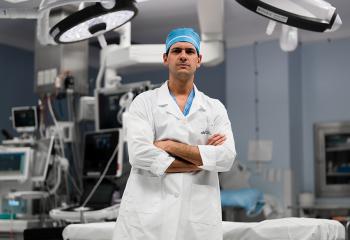
While TAVI focuses on aortic valve replacement, the QEII’s new minimally invasive cardiac surgery (MICS) program is bringing similar innovation to other complex heart procedures, like mitral valve repair and replacement. Surgeries that required opening the chest through the breastbone can now be performed through small incisions between the ribs. So far, QEII cardiac surgeons like Dr. Roberto Riberio report that incisions have reduced from 20-25 cm to just 3 cm.
For certain patients, this can mean less pain, shorter hospital stays, and faster recoveries – which means patients like Stuart getting back to their daily lives, sooner.
After his experience, Stuart is excited about the future of cardiac care at the QEII. He intends to leave a gift through the QEII Foundation to support QEII cardiac care teams in providing exceptional care to patients like him.
Stuart also thinks it’s important to support new advancements in cardiac care, like the QEII’s new MICS program, to help propel what feels like achieving the impossible.
“Twenty years ago, if you heard you have to have heart surgery, and we're gonna replace a valve in your heart, you’d nearly faint and fall over,” says Stuart.
“Now, there’s nothing to it.”
This advanced level of minimally invasive surgical care makes such a difference for Nova Scotians like Stuart. With the QEII’s new MICS program, even more heart health patients will benefit from potentially faster recovery times, smaller incisions, and returning to their daily lives sooner. Right now, all donations to the MICS program are DOUBLED up to $30,000 by two anonymous matching donors. Donate now.