

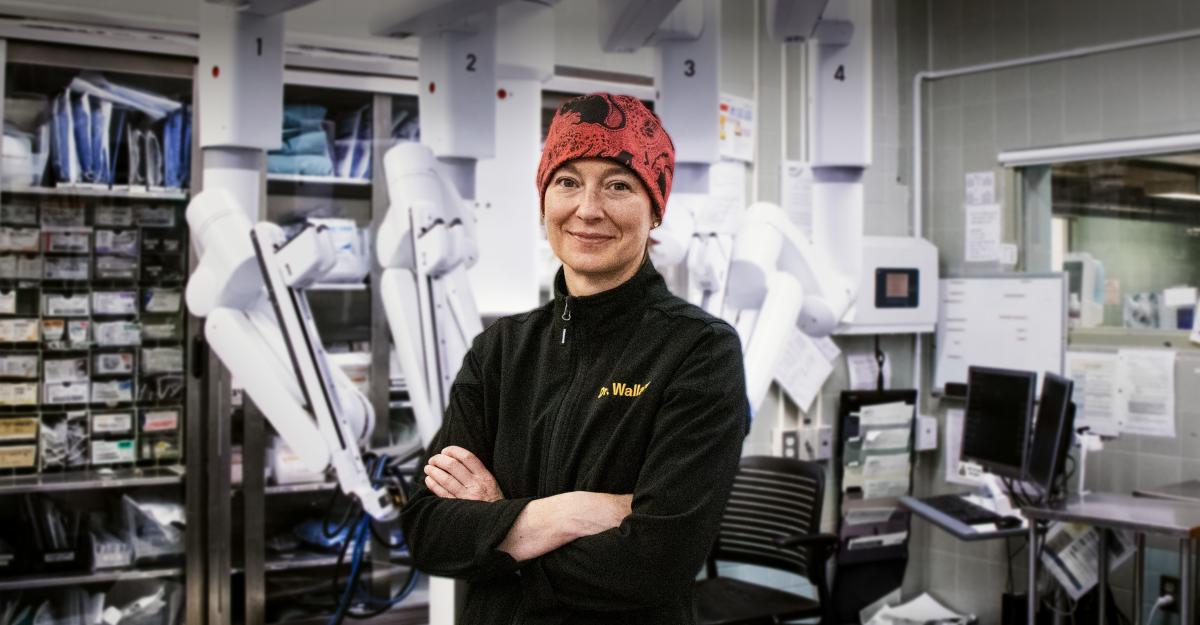
Pictured: Dr. Alison Wallace, QEII thoracic surgeon, with the QEII’s da Vinci Xi robot in the newly unveiled Anthony and Nouha Metlege Surgical Robotics Suite.
On January 19, 2026, as Halifax was blanketed in snow and much of the city was without power, inside an operating room at the QEII Health Sciences Centre, something groundbreaking was happening.
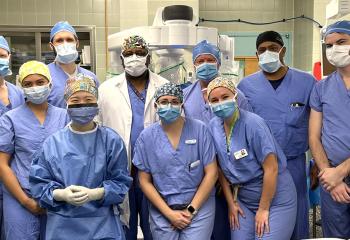
Using the hospital’s newest surgical robot — the da Vinci Xi — the thoracic surgery team performed Nova Scotia’s first robot-assisted thoracic procedures.
For Dr. Alison Wallace, a thoracic surgeon at the QEII, it was a milestone that captured both the potential of the technology and the urgency of the work.
“Lung cancer is the leading cause of cancer death in Nova Scotia,” says Dr. Wallace. “With the da Vinci Xi robot, we can perform more complex cases with greater precision and potentially offer curative surgery to more patients.”
That moment — unfolding against the backdrop of a major storm — was made possible through a powerful partnership between care teams, healthcare leaders, government and a passionate community of donors. Through its We Are campaign, the QEII Foundation is contributing $3.8 million to help fund the da Vinci Xi robot, expanding access to advanced surgical care and helping unlock entirely new treatment options for local patients.
A NEW OPTION FOR A GROWING CHALLENGE
Nova Scotia continues to face some of the highest lung cancer rates in the country. While smoking remains a major risk factor, a growing number of patients diagnosed with lung cancer have never smoked — a reality increasingly linked to environmental exposures such as radon.
For patients, diagnosis can come unexpectedly and, often, later than it should. For care teams, it reinforces the need for more advanced and adaptable treatment options.
Thoracic surgery, which includes procedures on the lungs and esophagus, plays a central role in treating many of these cases and requires surgeons to operate within some of the body’s most delicate anatomy.
“We’re often operating around critical structures like the pulmonary artery, where precision is essential,” says Dr. Wallace.
The da Vinci Xi is changing how some of these procedures can be performed, particularly for more complex lung cancer cases.
“This robotics technology allows us to operate in the chest with enhanced visualization and control,” explains Dr. Wallace. “With conventional instruments, movements are relatively rigid — the robot provides greater dexterity.”
According to Dr. Wallace, the new robotics technology allows care teams to work more effectively in confined spaces, approach tissue from different angles and operate with improved visualization.
“That added precision is particularly valuable in patients who have received chemotherapy or immunotherapy, where tissue planes can be more challenging,” she says. “The robot helps us perform these operations more safely.”
For eligible patients, this approach can also mean a less invasive procedure.
“There is good evidence that robotic-assisted thoracic surgery is associated with less pain, fewer complications and shorter hospital stays,” says Dr. Wallace. “That’s important, as surgery is often one component of a patient’s overall cancer treatment, and recovery impacts their ability to move on to additional therapies.”
It can also mean some patients can receive their care closer to home.
“In some cases, patients with more complex disease would previously have needed to travel for surgery,” she says. “This technology allows us to expand the care we can provide here at the QEII.”
EXPANDING ACCESS, CAPACITY AND IMPACT
Supported by QEII Foundation donors, the da Vinci Xi technology is increasing the number of gynecologic and ear, nose and throat (ENT) cancer surgeries performed each week at the QEII, while bringing robotics to new areas including thoracic, hepato-pancreato-biliary (diseases of the liver, pancreas, gallbladder and bile ducts) and colorectal care.
The impact is already being felt. In January 2026, the QEII performed more da Vinci robot-assisted surgeries than any other hospital in Canada — reinforcing its role as a national leader in surgical robotics. The hospital is now home to seven surgical robots, six of which are funded by QEII Foundation donors, supporting care across multiple specialties. The latest addition of the da Vinci Xi marks the QEII’s second da Vinci system; two robots laser-focused on minimally-invasive cancer surgeries.
For surgeons, the benefits extend far beyond the operating room.
“Surgery is physically demanding,” says Dr. Wallace. “The robotic platform allows for a more ergonomically sustainable way to operate, which is important over the course of a career.”
It’s also a critical tool for attracting, training and retaining the next generation of surgeons.
“Access to robotic surgery is increasingly expected by trainees and surgeons,” she adds. “It’s an important part of modern surgical training and practice across many centres in North America.”
POWERED BY PARTNERSHIP AND THE GENEROSITY OF DONORS
The da Vinci Xi is part of a broader initiative to transform surgical care at the QEII through the establishment of Canada’s first Centre of Excellence in Robotic Surgery — a vision supported by QEII Foundation donors, Nova Scotia Health and government partners.
Leadership gifts from David and Dinah Grace, Tony and Julie Metlege, and the Orchid Women’s Health Initiative — alongside the generosity of more than 1,300 other QEII Foundation donors — have been instrumental in bringing this technology to Nova Scotia.
Notably, the Grace family’s early support of the da Vinci Xi helped enable the expansion of robot-assisted surgery into thoracic care — directly impacting patients facing lung cancer today.
As the QEII Foundation’s president and CEO Susan Mullin explains, this new surgical robot reflects what’s possible when a community comes together around a shared vision for better care.
“Donor support has been essential in accelerating the adoption of surgical robotics at the QEII,” says Susan. “Through our We Are campaign, donors helped bring Atlantic Canada’s first da Vinci surgical robot to Halifax in 2019 — and today, they are building on that foundation with a second system, strengthening surgical capacity and enabling more innovative treatment options.”
As Dr. Wallace shares, one of the first patients to undergo robot-assisted thoracic surgery at the QEII came from the Mennonite community — a group often associated with simpler, more traditional ways of life. In this case, they were keen to be at the forefront of one of the most advanced forms of surgical care available.
It’s a powerful reminder that behind every advancement are patients facing complex diagnoses and care teams working together with donors to help expand what’s possible in their treatment and care.